
The Andes: Where the Sky Meets the Stone
The Argentine Andes stretch for over 2,000 kilometres along the country’s western flank, a spine of snow-capped peaks, deep valleys, and crystalline lakes. This is a land that demands reverence. The air is thin, the light is sharp, and the mountains seem to pulse with ancient, indifferent power.
At the heart of this range stands Mount Aconcagua, the undisputed giant of the Americas. Rising to 6,962 metres above sea level, it is the highest peak outside the Himalayas and a magnet for mountaineers from every corner of the globe. The mountain is part of Aconcagua Provincial Park, which draws between 6,000 and 7,000 visitors each season, primarily during the summer months from December to March. For those who do not aspire to the summit, the park offers something equally profound: the chance to stand in the shadow of the Western Hemisphere’s tallest mountain, to gaze upon its south face—one of the world’s most formidable climbing walls—and to feel, if only for a moment, the humility that such grandeur inspires.
The gateway to this world is Mendoza, a city where wine and wilderness converge in perfect harmony. Here, the vineyards of Luján de Cuyo and the Uco Valley stretch out beneath the watchful gaze of the Andes, offering tastings of world-renowned Malbec with snow-capped peaks as a backdrop. Beyond the bodegas, the Mendoza River invites adventurers to raft its whitewaters, while horseback trails wind through the foothills. Mendoza is Argentina at its most flavorful and free-spirited—a place where you can sip bold reds under the sun and, hours later, find yourself hiking through landscapes that feel older than time itself.
But the Andes are not a single story. Travel north to the provinces of Salta and Jujuy, and the mountains transform into something almost surreal. Here, the Quebrada de Humahuaca—a narrow valley carved by the Rio Grande over millennia—unfolds in a riot of colour. The Hill of Seven Colours near the village of Purmamarca is a geological masterpiece, its sedimentary layers banded in reds, greens, yellows, and violets, shaped by mineral content and millennia of erosion. Nearby, the Salinas Grandes salt flats stretch across more than 200 square kilometres, a vast white desert where the crystallised salt merges with the deep blue sky in an almost hallucinatory display. This is the Argentina of the high-altitude puna, a land of stark, otherworldly beauty that has been inhabited for thousands of years.
Iguazú: The Roar of the Jungle
From the arid heights of the Andes, the journey eastward is a descent into another world entirely. Some 1,300 kilometres northeast of Buenos Aires, in the province of Misiones, the Iguazú River hurtles towards a basalt ledge and plunges into one of the most spectacular natural wonders on the planet.
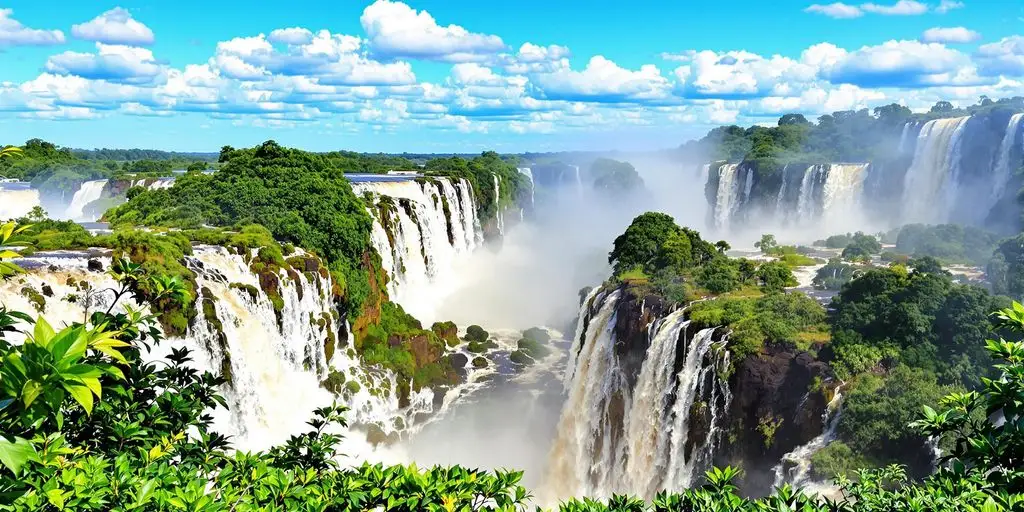
Iguazú Falls is not a single waterfall but a massive chain of over 275 individual cascades, stretching nearly three kilometres across the border between Argentina and Brazil. Some drops reach 80 metres in height, and the constant mist rising from the crashing water creates rainbows that dance in the subtropical light. At the heart of this system is the Devil’s Throat (Garganta del Diablo), a U-shaped chasm where a colossal volume of water funnels into a narrow gorge, generating a roar that can be heard from miles away. It is, quite simply, overwhelming.
The falls were declared a UNESCO World Heritage Site in 1984 and named one of the New Seven Natural Wonders of the World. The Argentine side, where approximately 80% of the falls are located, offers the most comprehensive experience. A network of walkways and trails allows visitors to explore the falls from every angle: the Upper Circuit provides sweeping panoramic views from above; the Lower Circuit brings you thrillingly close to the base of the cascades; and the Devil’s Throat trail leads you on a 1,100-metre walkway across the river to the very edge of the plunge. For the adventurous, boat rides speed into the rapids, delivering a drenching and unforgettable perspective from the river itself.
Surrounding the falls is Iguazú National Park, a protected subtropical forest teeming with life. Toucans flash their brilliant beaks through the canopy, coatis forage along the trails, and the air is thick with the songs of birds and the buzz of butterflies. It is a place where nature feels unmediated—raw, vibrant, and utterly indifferent to the humans who come to gawk.
A Land of Contrasts
To travel from the Andes to Iguazú is to witness the full spectrum of Argentina’s natural heritage. In the west, the mountains demand silence and respect; their beauty is austere, monumental, shaped by wind and ice over millions of years. In the northeast, the jungle erupts in a symphony of sound and colour; the water never stops moving, and life flourishes in every corner. One landscape is carved from stone; the other is written in water. Together, they tell the story of a country that refuses to be defined by a single image.
Argentina’s terrain reflects the country’s size and geological complexity. From ice fields to tropical rivers, from high plateaus to ocean cliffs, the range of natural features is extensive and varied. But for those who seek the extraordinary—the kind of wonder that stops you in your tracks and reminds you of the planet’s raw power—the journey from the Andes to Iguazú is as good as it gets. It is a pilgrimage across a continent, a reminder that some things are too grand to be captured in photographs, and an invitation to stand, for a brief moment, at the intersection of earth, water, and sky.