
Three days is the right length for a first Paris visit. Two days collapses the city into a sprint; four to five days lets you add Versailles or a day trip but doesn’t fundamentally change the structure. Three days lets you see the headline monuments well, do one museum at depth, and have evenings that aren’t rushed.
This is a working itinerary built around the city’s working light windows and the natural east-west flow of the Seine. Each day is built around one geographic cluster so you’re not crossing the city repeatedly.
Before you arrive
Book the major sights online ahead of time. The Louvre, the Eiffel Tower summit, and Versailles require timed entry and the on-site queue can run two hours in peak season. Notre-Dame reopened in December 2024 with timed-entry reservations (free); reserve a slot.
Paris Museum Pass. €70 for 2 days or €85 for 4 days. Covers Versailles, the Louvre, the Orsay, the Centre Pompidou, the Arc de Triomphe roof, Sainte-Chapelle, and ~50 other sites. Strong value for active 3-day visitors.
Where to stay. The Marais (4th arrondissement) for walking access. Saint-Germain (6th) for the classic Left Bank version. The 9th and 10th for budget options with metro access. Avoid hotels in the immediate vicinity of Gare du Nord, Gare de l’Est, and around the Champs-Élysées — the immediate areas are either grim or tourist-trap territory.
Day 1 — The Eiffel Tower, the Trocadéro, and the western core
Early morning (6:30–8:30 a.m.) — Trocadéro and the Eiffel Tower
Trocadéro plaza is the standard composition window for the Eiffel Tower. Be there before 7 a.m. — the plaza is empty and the morning light hits the tower frontally. The light works best when the sun is low (April–September); in winter, plan for blue-hour photography instead.
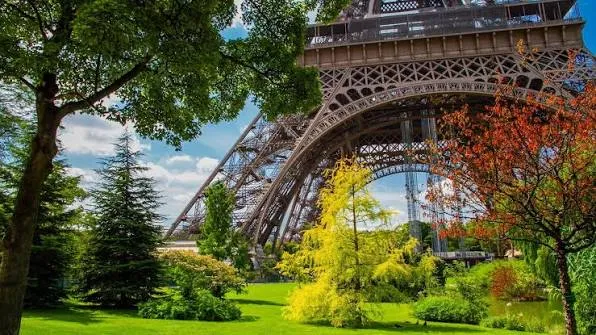
After the plaza shot, walk through the Trocadéro Gardens down to the Seine and across the Pont d’Iéna toward the tower itself. The Champ de Mars behind the tower gives the classic vertical composition with the tower centered and 1.5 kilometers of formal gardens stretching south.
Mid-morning (8:30–11 a.m.) — Eiffel Tower climb
Book a second-floor ticket (around €19) or summit ticket (around €29) online. The second floor (115 meters) is the photographic sweet spot — high enough for the panorama, low enough that you can identify individual buildings. The summit (276 meters) gives a more abstract overhead view.
If you have a museum pass, prioritize the views over the climb. Walking up the stairs (674 steps to the second level) is workable if you’re fit; the queue is shorter than the elevator.
Lunch — neighborhood option
Walk east along the Seine to Trocadéro side or take the metro to Saint-Germain (Line 9 to Pont de l’Alma, then bus). For a working lunch: Café Constant (modern bistro) or Les Cocottes (both in the 7th arrondissement, photographer-friendly menu).
Afternoon (1:30–4:30 p.m.) — Musée Rodin or Les Invalides
Musée Rodin (GPS 48.8554° N, 2.3155° E) — the most rewarding small museum in Paris. Auguste Rodin’s working studio and his sculpture collection in the 18th-century Hôtel Biron. The Garden with The Thinker, The Gates of Hell, and The Burghers of Calais is the photographic anchor. Entry around €14; the garden is reduced-price (€5) for visitors only doing the outdoor section. Allow 90 minutes.
Les Invalides is the alternative — Napoleon’s tomb, the Military Museum, the gilded dome. More substantial but less photographically rewarding than the Rodin for first-time visitors. Allow 2 hours.
Late afternoon (5–7 p.m.) — Arc de Triomphe and the Champs-Élysées
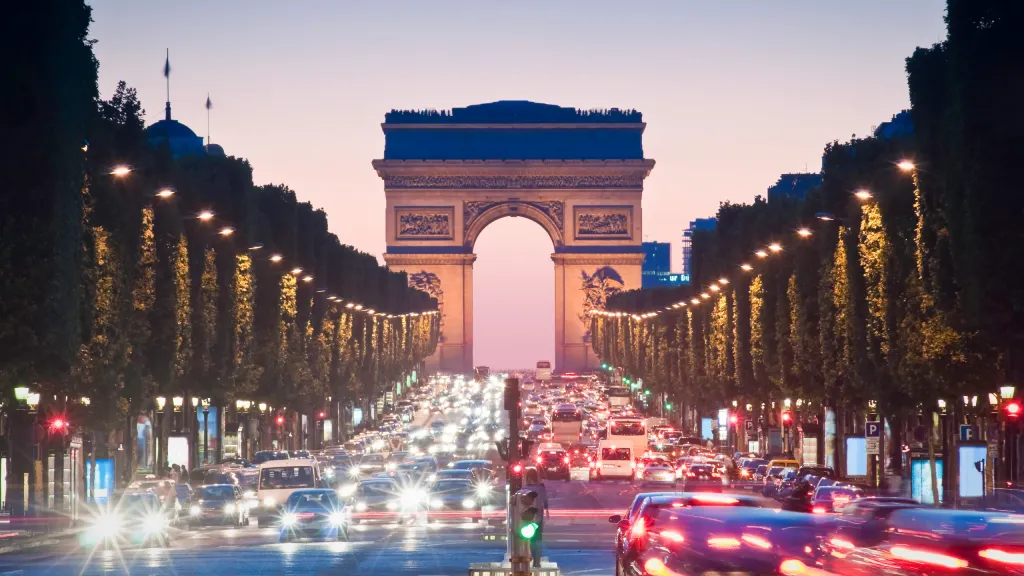
Metro to Charles de Gaulle–Étoile. The Arc de Triomphe roof (around €13, free with museum pass) gives the radial city view with the 12 avenues converging on the Place de l’Étoile. Best in late afternoon when the western sun lights the Champs-Élysées below.
Walk back down the Champs-Élysées toward the Place de la Concorde. The shopping strip is photographically weak; the value is in the Arc roof and the Concorde at sunset.
Evening (7:30 onwards) — Seine cruise + dinner
Sunset Seine cruise from the Pont de l’Alma or Pont Neuf — 1 hour, around €17. Operators include Bateaux Mouches and Bateaux Parisiens; both run identical routes. The working window is the hour before sunset.
Dinner in Saint-Germain or the 6th arrondissement — central enough to walk from the river, plenty of options at every price point.
Day 2 — The Louvre, the central monuments, Montmartre
Early morning (7–9 a.m.) — The Louvre Pyramid + Tuileries
The Louvre Pyramid (GPS 48.8606° N, 2.3376° E) at first light is the strongest contemporary-architecture photograph in central Paris. The courtyard is empty, the pyramid catches dawn light. Photographic only — the museum doesn’t open until 9 a.m.
Walk through the Tuileries Garden west to the Place de la Concorde. Formal French parterres, sculptures by Maillol, the Orangerie (with Monet’s Water Lilies) at the western end.
Mid-morning (9 a.m.–1 p.m.) — The Louvre
Book a 9 a.m. timed entry. Four-hour minimum for a serious first visit; a full day for a thorough one.
A working priority list:
- Denon Wing, first floor: Mona Lisa, then the surrounding Italian Renaissance gallery (Da Vinci’s Virgin of the Rocks and Saint Anne, Veronese, Titian)
- Denon Wing, ground floor: Venus de Milo, Greek and Roman antiquities, the Winged Victory of Samothrace
- Sully Wing, lower level: the medieval Louvre foundations (the original 12th-century fortress walls are visible)
- Richelieu Wing: Mesopotamian and Egyptian antiquities; the Napoleon III apartments
Skip if short on time: the European decorative arts (impressive but slow), the temporary exhibitions ticket add-ons.
Lunch — Café Marly or Le Fumoir
Café Marly is inside the Louvre’s Cour Napoléon arcade, with terrace tables looking directly at the Pyramid. Pricey but the location is the working draw. Le Fumoir (two blocks east) is the locals’ version at a third the price.
Afternoon (2:30–5 p.m.) — Sainte-Chapelle, Notre-Dame, Île de la Cité
Sainte-Chapelle (GPS 48.8554° N, 2.3450° E) — the single most photographically rewarding interior in Paris. The 1,113-scene stained glass program in the upper chapel works best in midday sun (11 a.m.–2 p.m.). Entry around €13, free with museum pass.
Notre-Dame (GPS 48.8530° N, 2.3499° E) — the reopened cathedral. Reserve a free timed slot online; on-site walk-ins limited to specific hours. The exterior from the Pont au Double or the western square is photographable without entry.
Île de la Cité walk — the small island streets behind the cathedral, the Mémorial des Martyrs de la Déportation at the eastern tip, the flower market on Place Louis Lépine.
Late afternoon (5–7 p.m.) — Metro to Montmartre
Take Line 12 to Abbesses station. The Wall of Love at Place des Abbesses (“I love you” in 250 languages). Walk up via Rue Lepic — the working street photography route — to Place du Tertre and the Sacré-Cœur basilica.
Evening (7 onwards) — Sacré-Cœur at sunset, dinner in Montmartre
Sacré-Cœur (GPS 48.8867° N, 2.3431° E) — the white basilica on the highest hill in Paris. Free interior; the dome climb (around €8) gives the strongest elevated city view available without a ticket queue. Sunset from the lower steps is the standard composition.
Dinner in Montmartre — Le Coq Rico, La Cantine de la Cigale, or any of the smaller bistros on Rue des Trois Frères. Avoid the immediate Place du Tertre restaurants — tourist-trap prices.
Day 3 — The Latin Quarter, the Orsay, and a slower pace
Early morning (8–10 a.m.) — Latin Quarter walking circuit
Start with coffee at Le Procope (Paris’s oldest café, 1686) or Café de Flore if you want the canonical Left Bank stop. Walk through the Latin Quarter — Rue Saint-André-des-Arts, Place Saint-Michel, Rue de la Huchette (the narrowest old street).
Shakespeare and Company (GPS 48.8527° N, 2.3473° E) — the historic English-language bookshop opposite Notre-Dame. Genuinely photogenic interior; tight crowds after 11 a.m.
Les Bouquinistes — the green wooden bookstall boxes lining the Seine on both banks. UNESCO-recognized since 1991. Walk eastward toward the Île Saint-Louis for the working morning light angle.
Mid-morning (10 a.m.–1 p.m.) — Musée d’Orsay
Musée d’Orsay (GPS 48.8600° N, 2.3266° E) — the converted 1900 Beaux-Arts railway station, now the world’s most important Impressionist and Post-Impressionist collection. Monet, Renoir, Degas, Cézanne, Van Gogh, Gauguin, Toulouse-Lautrec, Manet. Entry around €16; free with museum pass.
For working photographers: the central clock on the fifth floor, viewed from the inside facing the Seine, is the museum’s signature interior composition. Allow at least 3 hours.
Lunch — Le Comptoir du Relais or Le Petit Saint-Benoît
Saint-Germain neighborhood, both classic Left Bank bistros.
Afternoon (2:30–4:30 p.m.) — Choose one
Option A: The Panthéon (GPS 48.8462° N, 2.3464° E). The neoclassical mausoleum of French national figures — Voltaire, Rousseau, Hugo, Curie, Dumas, Foucault. Foucault’s pendulum in the nave is the iconic interior subject. Entry around €13.
Option B: Père-Lachaise Cemetery (GPS 48.8611° N, 2.3936° E). The most-visited cemetery in the world — 70,000 tombs across 44 hectares. Oscar Wilde, Jim Morrison, Édith Piaf, Chopin, Proust. Free entry; bring a paper map. Most photogenic in autumn fog.
Option C: The Catacombs (GPS 48.8338° N, 2.3324° E). 1.5 kilometers of underground ossuary chambers containing the remains of 6 million Parisians. Strict timed entry; book online weeks ahead in peak season. Around €29.
Late afternoon (5–7 p.m.) — Marais walking circuit
Metro Line 1 to Saint-Paul. The Marais quarter — the medieval Jewish quarter that became the city’s gay quarter and is now one of the most fashionable arrondissements. Place des Vosges (1605, the oldest planned square in Paris), Rue des Rosiers, the Musée Picasso, and the Musée Carnavalet (Paris history, free).
Evening (7 onwards) — Last dinner
For a high-end Parisian dinner: L’Ami Jean (Basque-influenced bistro), Septime (modern Parisian, books months ahead), or Le Chateaubriand (the natural-wine influential bistro).
For a casual final evening: Place des Vosges terrace cafés, or one of the wine bars on Rue Charlot.
Day-trip options if you have 4–5 days
Versailles (30 min by RER C) — half-day or full day; covered in the Paris Best Places guide.
Giverny (1 hour by train + bus) — Monet’s house and water-lily gardens. April–October only. Half-day.
The Champagne Region (Reims) (45 min by TGV) — the chalk caves of Veuve Clicquot, Pommery, Taittinger, and Mumm. Full day.
Mont Saint-Michel (3 hours each way) — possible as a long day trip but better as an overnight.
The D-Day beaches (Normandy) (2 hours each way to Caen) — Omaha Beach, the American cemetery, the Bayeux Tapestry. Full day; better with a guided tour.
A working photographer’s quick reference
| Time of day | Where to be | Why |
|---|---|---|
| Dawn (6–8 a.m.) | Trocadéro / Eiffel Tower / Louvre Pyramid | Empty plazas, soft light |
| Late morning (10 a.m.–noon) | Sainte-Chapelle | Midday sun through the stained glass |
| Afternoon (2–5 p.m.) | Indoor museums (Louvre, Orsay) | Avoid the harshest light outdoors |
| Late afternoon (5–7 p.m.) | Arc de Triomphe roof, Tuileries, Sacré-Cœur | The working golden hour |
| Sunset to blue hour | Trocadéro for Eiffel Tower lighting, Pont des Arts | The signature evening |
| After dark | Île de la Cité, Marais, illuminated monuments | Night photography |
Logistics
| How to arrive | CDG and Orly airports both connect to central Paris by RER. From CDG: RER B (30 min, €11.45). From Orly: Orlybus + metro (45 min, €11). |
| Public transit | The Paris Métro is the standard answer. A carnet of 10 tickets (€19.10) or the Navigo Easy chip card is the better value than singles. |
| Best months | Mid-May to June, mid-September to mid-October. Avoid August (much of Paris closes for vacation) and the week between Christmas and New Year. |
| Photography permits | Tripods permitted in public squares and parks. Prohibited inside the major museums (handheld permitted except where flagged) and inside Sainte-Chapelle. |
| Photography prohibition zones | The Eiffel Tower’s evening sparkle (every hour on the hour after dark) is technically copyrighted; personal photography is permitted, but commercial use requires a license. |
What to skip
The Mona Lisa room if you’re not committed. Da Vinci’s Saint Anne and Virgin of the Rocks are in the adjacent gallery and are stronger paintings with no crowd.
Most Champs-Élysées restaurants. Walk three streets in any direction for the working version of the same neighborhood.
Tickets for the on-the-hour Eiffel Tower sparkle. The lighting is automatic; the show is free; you don’t need anything special to see it.
Same-day visit-to-Mona-Lisa-then-leave Louvre trips. You’re paying €22 to see one painting in a crowd of 200. Either commit to a substantial museum visit or skip the Louvre.
FAQ
Is 3 days enough for Paris?
For the headline city, yes. For Paris plus serious day trips (Versailles, Giverny, Mont Saint-Michel), 4–5 days. For a deep-dive that includes the lesser-visited arrondissements and serious museum time, a full week.
Is Paris expensive?
Among the more expensive European cities, but with strong value at the mid-range. Budget €150–250 per person per day for hotel, meals, transit, and attractions; €300+ for upper-mid; €600+ for serious luxury. Museum Pass + carnet metro tickets + lunchtime menus reduce the working cost by 30–40%.
Best month for first-time visitors?
Mid-May or mid-September. Pleasant weather, long days, manageable crowds. Avoid August (half the city is closed) and the major French holidays (Bastille Day July 14, All Saints’ Day November 1, the Christmas week).
Should I buy the Paris Museum Pass?
For a 3-day itinerary visiting four or more major sites (Louvre + Orsay + Sainte-Chapelle + Versailles, for example), yes — the math works strongly. For a 2-day itinerary or one focused on free attractions, single tickets are cheaper.
Is Paris safe?
Yes, with normal urban awareness. The historic central arrondissements (1st through 8th, 16th) are safe at all hours. Pickpocketing is the main concern at major tourist sites — particularly the Trocadéro, the Louvre area, and the metro. Keep your phone in a front pocket; never leave a bag unattended.